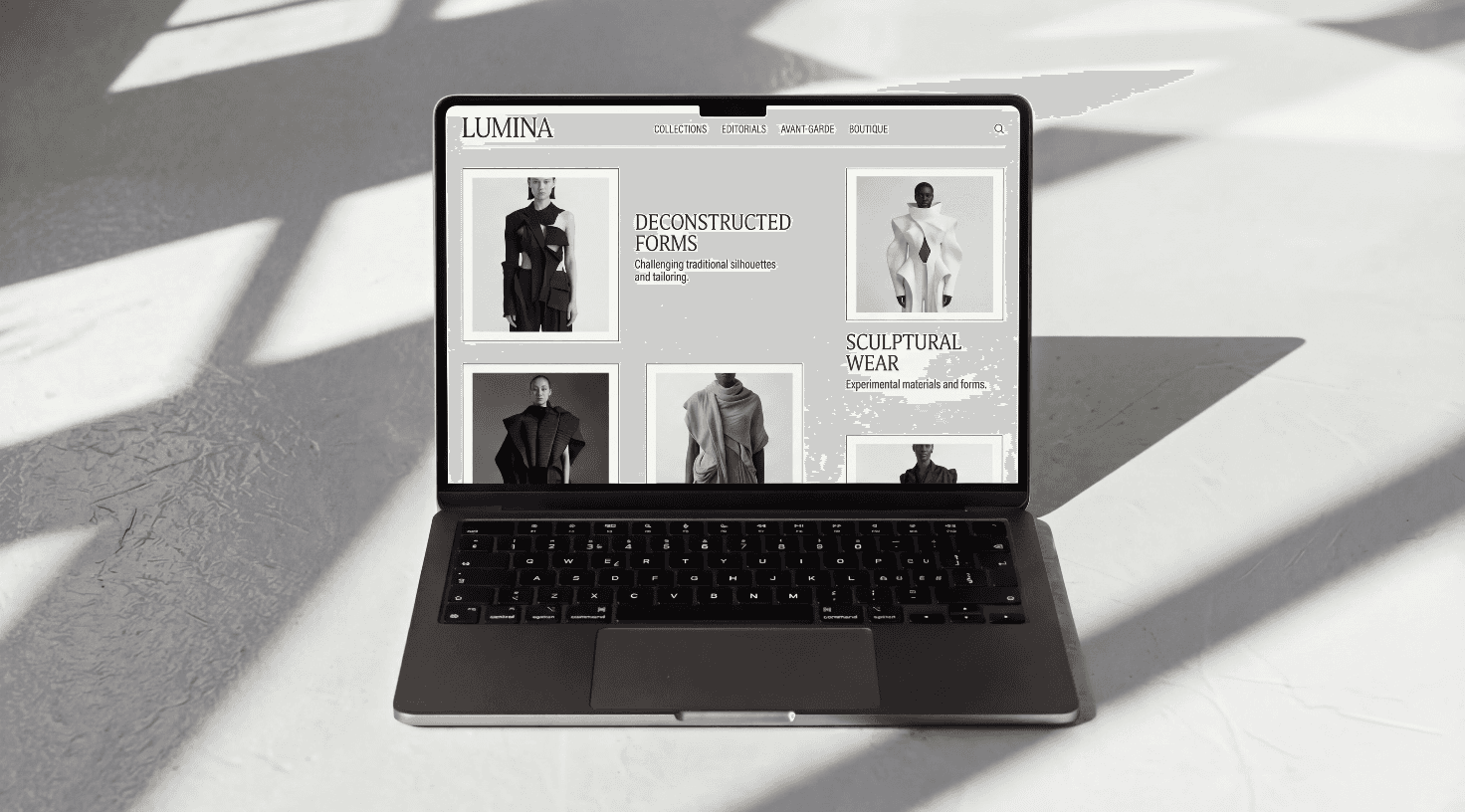
People often assume that premium digital work comes from spectacle. A larger hero. More animation. Bigger imagery. More dramatic transitions. But the feeling of cost rarely comes from scale alone. It comes from precision.
A website feels expensive when nothing seems accidental. Type sits where it should. Spacing holds across screen sizes. Images enter with the right tempo. Motion does not oversell itself. The whole thing feels edited, measured, and calm under pressure.
Proportion Is the First Signal
Before users notice concept, they notice proportion. They register whether the page feels balanced, whether the type breathes properly, whether the margins hold, whether content density changes at the right moments. They may never describe those things directly, but they feel them immediately.
Poor proportion makes even strong visual assets feel cheaper than they are. Good proportion does the opposite. It allows very little to feel substantial. It gives the interface confidence without relying on visual noise.
Motion Has to Know Its Place
Motion can help a site feel more refined, but only when it is clearly in service of the reading. The best transitions do not interrupt. They connect. They clarify where the user is, what changed, and how one layer relates to another.
What makes motion feel expensive is not complexity. It is restraint. A fast fade timed well will often feel more resolved than a dramatic sequence inserted everywhere. The same applies to hover states, page reveals, and scroll behaviour. The effect is stronger when it behaves like part of the system rather than a performance added on top.
Control Is What People Actually Read
When people say a site feels premium, they are often describing control without naming it. They are reacting to the discipline of the whole. A stable hierarchy. A measured pace. An absence of clutter. A sense that every decision has already been tightened.
That is what changes the perception of value. Not just visual quality, but visual certainty.
People often assume that premium digital work comes from spectacle. A larger hero. More animation. Bigger imagery. More dramatic transitions. But the feeling of cost rarely comes from scale alone. It comes from precision.
A website feels expensive when nothing seems accidental. Type sits where it should. Spacing holds across screen sizes. Images enter with the right tempo. Motion does not oversell itself. The whole thing feels edited, measured, and calm under pressure.
Proportion Is the First Signal
Before users notice concept, they notice proportion. They register whether the page feels balanced, whether the type breathes properly, whether the margins hold, whether content density changes at the right moments. They may never describe those things directly, but they feel them immediately.
Poor proportion makes even strong visual assets feel cheaper than they are. Good proportion does the opposite. It allows very little to feel substantial. It gives the interface confidence without relying on visual noise.
Motion Has to Know Its Place
Motion can help a site feel more refined, but only when it is clearly in service of the reading. The best transitions do not interrupt. They connect. They clarify where the user is, what changed, and how one layer relates to another.
What makes motion feel expensive is not complexity. It is restraint. A fast fade timed well will often feel more resolved than a dramatic sequence inserted everywhere. The same applies to hover states, page reveals, and scroll behaviour. The effect is stronger when it behaves like part of the system rather than a performance added on top.
Control Is What People Actually Read
When people say a site feels premium, they are often describing control without naming it. They are reacting to the discipline of the whole. A stable hierarchy. A measured pace. An absence of clutter. A sense that every decision has already been tightened.
That is what changes the perception of value. Not just visual quality, but visual certainty.
(OBSERVATION)